
Prep Classes

Inquiry and Creative Thinking
Developing curiosity and questioning skills is a core goal of the PYP. Interdisciplinary themes provide unique contexts for students to explore themselves and the world around them.
Various activities foster critical and creative thinking. Students reflect on their learning and behaviors, set developmental goals, and incorporate these goals into their daily lives.
Artistic and Physical Development
Artistic activities support students in using their imaginations to create, fostering both creativity and aesthetic understanding. We offer diverse opportunities for children to express themselves across various disciplines. In alignment with the PYP’s transdisciplinary approach, these activities are integrated into students’ inquiry and exploration, making them more meaningful and enjoyable.
- Visual Arts: Activities allow children to experiment freely with aesthetic elements such as color, texture, and shape, encouraging creativity and self-expression.
- Robotics and Coding: These activities inspire students to use technology creatively, enhancing problem-solving, logical thinking, and innovative project development skills.
- Music: Students discover rhythm, develop listening skills, and learn to express emotions through music. Songs, rhythmic games, and musical activities strengthen memory, attention, and coordination.
- Ballet and Gymnastics: These practices enhance body awareness, aesthetic movement skills, balance, and a disciplined work ethic.
- Physical Education and Games: Sports and games promote both physical and social development. Group activities teach values such as teamwork, leadership, and fair play, while sports improve physical endurance and coordination.
Academic and Cognitive Development
Our literacy and numeracy activities enhance students’ awareness of symbols and sounds while developing their mathematical thinking and problem-solving skills.
Our bilingual education program encourages language learning in natural contexts, making it enjoyable and meaningful. Through games, songs, and stories, children strengthen their communication skills, self-confidence, and cultural awareness while fostering a positive attitude toward language learning.
Activities such as cutting, folding, and drawing improve fine motor skills, while running, jumping, and climbing activities promote gross motor development.
Inquiry and Creative Thinking
Developing curiosity and questioning skills is a core goal of the PYP. Interdisciplinary themes provide unique contexts for students to explore themselves and the world around them.
Various activities foster critical and creative thinking. Students reflect on their learning and behaviors, set developmental goals, and incorporate these goals into their daily lives.
Artistic and Physical Development
Artistic activities support students in using their imaginations to create, fostering both creativity and aesthetic understanding. We offer diverse opportunities for children to express themselves across various disciplines. In alignment with the PYP’s transdisciplinary approach, these activities are integrated into students’ inquiry and exploration, making them more meaningful and enjoyable.
Our Preschool Educational Approach
At the foundation of our preschool educational practices lies the IB Primary Years Programme (PYP), which supports both the academic and personal development of our students. The PYP’s student-centered and inquiry-based approach fosters curiosity, lifelong learning, critical and creative thinking, and a deeper understanding of themselves and their surroundings.
A Holistic Development Approach
Our educational philosophy aims not only at academic success but also at nurturing individuals who embody the qualities of being good people. The PYP learner profiles help our students develop universal values such as empathy, integrity, responsibility, and collaboration. These values enable our students to contribute to society as ethical, respectful, and caring individuals. This holistic approach ensures that our students begin primary school with a strong foundation.
Academic and Cognitive Development
Our literacy and numeracy activities enhance students’ awareness of symbols and sounds while developing their mathematical thinking and problem-solving skills.
Our bilingual education program encourages language learning in natural contexts, making it enjoyable and meaningful. Through games, songs, and stories, children strengthen their communication skills, self-confidence, and cultural awareness while fostering a positive attitude toward language learning.
Activities such as cutting, folding, and drawing improve fine motor skills, while running, jumping, and climbing activities promote gross motor development.
Our Preschool Educational Approach
At the foundation of our preschool educational practices lies the IB Primary Years Programme (PYP), which supports both the academic and personal development of our students. The PYP’s student-centered and inquiry-based approach fosters curiosity, lifelong learning, critical and creative thinking, and a deeper understanding of themselves and their surroundings.
A Holistic Development Approach
Our educational philosophy aims not only at academic success but also at nurturing individuals who embody the qualities of being good people. The PYP learner profiles help our students develop universal values such as empathy, integrity, responsibility, and collaboration. These values enable our students to contribute to society as ethical, respectful, and caring individuals. This holistic approach ensures that our students begin primary school with a strong foundation.
Academic and Cognitive Development
Our literacy and numeracy activities enhance students’ awareness of symbols and sounds while developing their mathematical thinking and problem-solving skills.
Our bilingual education program encourages language learning in natural contexts, making it enjoyable and meaningful. Through games, songs, and stories, children strengthen their communication skills, self-confidence, and cultural awareness while fostering a positive attitude toward language learning.
Activities such as cutting, folding, and drawing improve fine motor skills, while running, jumping, and climbing activities promote gross motor development.
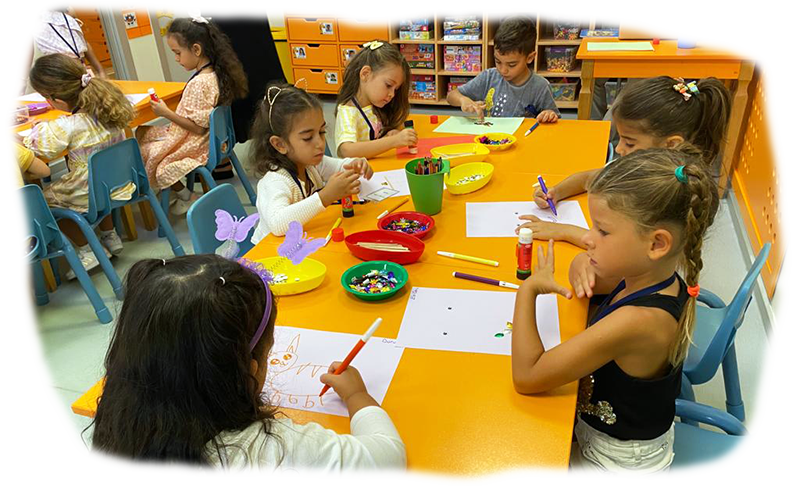
Social and Emotional Development
We organize activities to help students build positive relationships, collaborate, share, and develop leadership skills.
Social competencies like empathy, cooperation, and respect are cultivated through group work and social interactions. Emotional development activities teach children to recognize and appropriately express their emotions while fostering conflict resolution skills.
Self-Care and Responsibility Development
Self-care skills, such as personal hygiene, dressing, and eating independently, foster students’ autonomy.
Students are encouraged to evaluate their learning processes, helping them take ownership of both their academic and personal development. Through reflection, they identify their strengths and areas for growth, setting and striving to achieve developmental goals.
Preparing for Primary School
This holistic approach, designed according to PYP principles, considers each student’s individual needs, interests, and abilities. As a result, our children embrace their learning processes, grow with confidence, and transition to primary school well-prepared.


